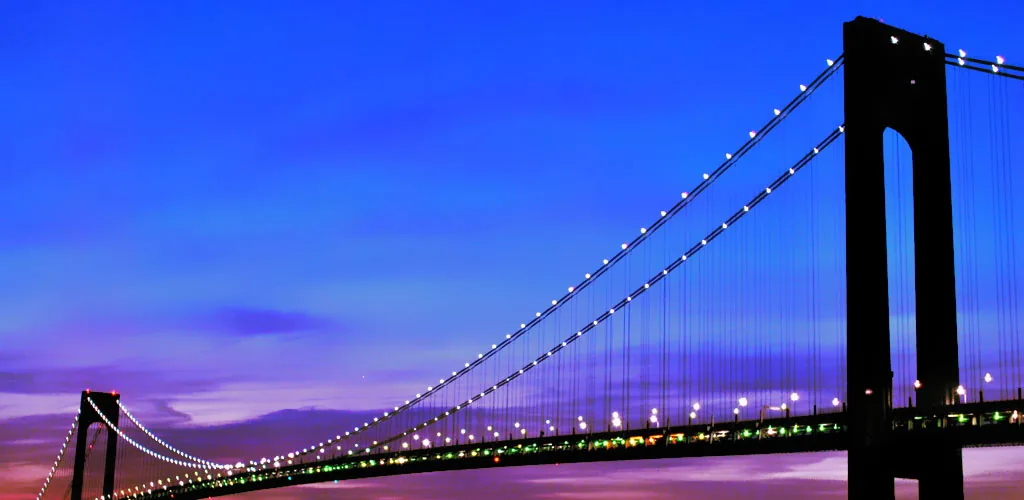
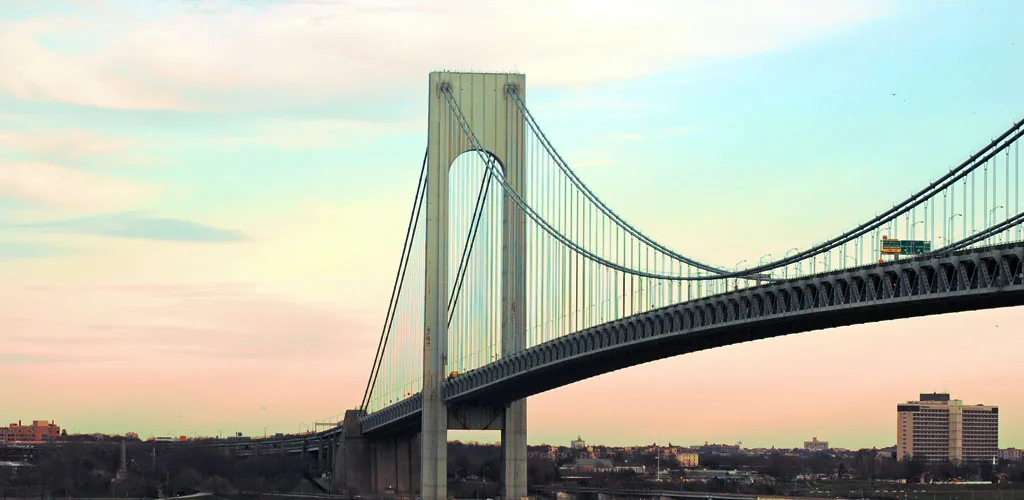
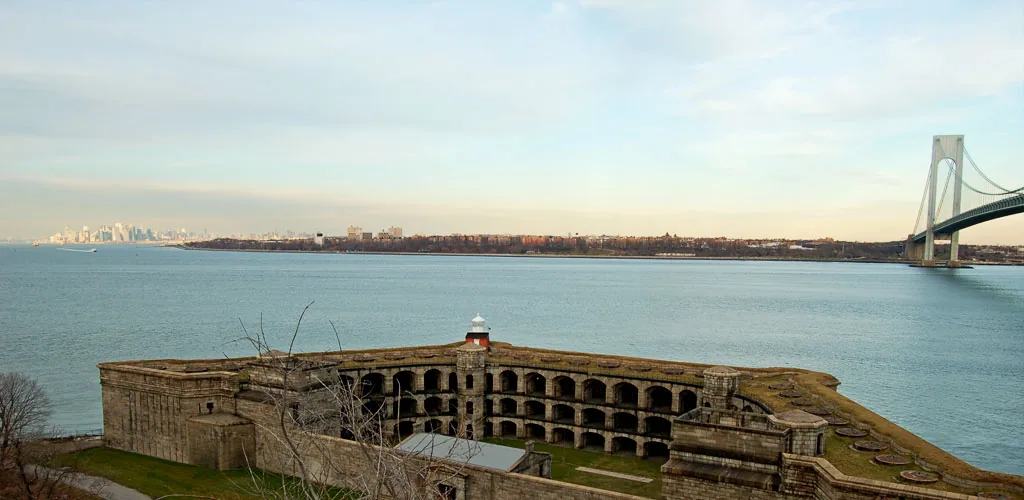
Verrazzano-Narrows Bridge for trucks
A 2-axle truck pays USD 13.49 a crossing with a New York E-ZPass and USD 24.07 by Tolls by Mail; at six axles or more it is USD 42.98 and USD 75.00. The toll is charged in both directions, so the round trip doubles it.
The price is the easy part. The bridge caps gross weight at 80,000 lb, sends anything over the New York State Bridge Formula or wider than 9 ft 6 in through a permit, and a night crossing permit means an 11 p.m. to 5 a.m. window. When the wind forecast turns it stops high-profile vehicles outright. The rates below are the MTA's 2026 schedule, effective 4 January 2026.
The toll, by axle
MTA prices a truck on axle count and on how you pay, not on the hour. Every figure is per one-way crossing, in USD.
| Vehicle class | NY E-ZPass (USD) | Mid-Tier (USD) | Tolls by Mail / non-NYCSC E-ZPass (USD) | Round trip, NY E-ZPass (USD) |
|---|---|---|---|---|
| 2-axle, over 7,000 lb gross weight | 13.49 | 18.87 | 24.07 | 26.98 |
| 3-axle | 22.10 | 31.00 | 39.62 | 44.20 |
| 4-axle | 28.26 | 39.08 | 49.54 | 56.52 |
| 5-axle | 36.84 | 51.19 | 65.10 | 73.68 |
| 6 axles or more | 42.98 | 59.26 | 75.00 | 85.96 |
A two-axle truck at or under 7,000 lb gross weight is not in this table at all: it pays the car rate of USD 7.46, USD 9.79 or USD 12.03. The truck classes begin above 7,000 lb.
There is no seven-axle rate and no per-axle charge past six. MTA's schedule ends at "6 axles or greater", so a seven-axle rig pays USD 42.98, USD 59.26 or USD 75.00 like a six-axle one.
The schedule does not change by hour. MTA charges the same truck rate at 3 a.m. as at 8 a.m., unlike the Port Authority crossings, which price trucks separately for overnight, off-peak and peak. What does vary is the facility: the major-crossing group — this bridge, the Robert F. Kennedy, Bronx-Whitestone and Throgs Neck bridges and the Queens Midtown and Hugh L. Carey tunnels — carries one truck schedule, while Cross Bay and Marine Parkway charge USD 6.75 for two axles and USD 21.50 for six or more on a New York E-ZPass.
The toll has been charged in each direction since 1 December 2020, so a 2-axle rig on a New York E-ZPass costs USD 26.98 for the round trip and a 5-axle costs USD 73.68. Car rates, the payment tiers and the Staten Island resident discount are on the Verrazzano-Narrows Bridge toll page; the tag itself, including where a commercial transponder is mounted, is covered in the E-ZPass guide.
Weight and width limits
The limits are the New York State Bridge Formula, and the same three numbers apply at every MTA bridge and tunnel.
| Limit | Figure | What it means at the crossing |
|---|---|---|
| Single axle | 22,400 lb | One axle over this is over the formula, whatever the gross weight reads. |
| Two axles | 36,000 lb | The pair is measured together, not as 2 × 22,400 lb. |
| Gross vehicle weight | 80,000 lb | A ceiling, not an allowance: a legal load can be under it and still over the formula. |
| Width, MTA bridges | 9 ft 6 in | Wider than this needs a night crossing permit. |
| Width, MTA tunnels | 8 ft 6 in | A load that fits the bridge can still be too wide for a tunnel. |
| Height | Posted per deck and direction | Over the clearance of the deck you use means a night crossing permit. |
Being under 80,000 lb is not the test. A truck can sit below the gross ceiling and still be over the bridge formula, and that is the load that gets turned around. Bridges and tunnels officers check trucks routinely, and the MTA warns that fines for non-compliance can exceed USD 10,000.
The posted clearance for each deck and direction, the hazmat rule that keeps hazardous materials on the upper level, and the ramp that puts you on each level are all on the how to get to the Verrazzano-Narrows Bridge page.
Permits: two routes, and only one of them is MTA's
Which permit you need turns on one question: can the load be split into smaller shipments?
Over-limit loads: the MTA night crossing permit
A divisible load over the bridge formula, taller than the clearance of the deck it uses, or wider than 9 ft 6 in on a bridge crosses under an MTA night crossing permit. The application has to be in two business days before the crossing, the move happens in the small hours, and the vehicle is off the facility by 5 a.m.
| Night crossing permit | Rule |
|---|---|
| Apply | Two business days before the crossing date |
| Travel window | 11 p.m. to 5 a.m. |
| Off the bridge by | 5 a.m. |
| In the cab | The MTA permit, plus any New York City permit |
| Where to apply | MTA Truck Permitting Unit, (646) 252-7136, [email protected] |
Every permitted vehicle is subject to inspection. Special handling permits are handled on 212-260-3000.
Non-divisible loads: New York City, not MTA
A load that cannot be broken down goes to the city instead. That covers a non-divisible load over 80,000 lb GVW, a load under 80,000 lb that is not bridge-formula compliant, and anything wider than 9 ft 6 in: all three need a daily over-dimensional permit from the New York City Department of Transportation before the vehicle reaches any MTA crossing. MTA issues no separate permit alongside a city one.
NYC DOT Bridges–Truck Unit, 55 Water Street, New York NY 10041, (212) 839-6341.
Divisible loads over 80,000 lb
A divisible load above 80,000 lb GVW needs an MTA Divisible Load Permit, and only an annual NYC DOT permit holder can get one. Since 5 a.m. on 26 May 2026, TBTA issues divisible load permits only to those annual permit holders. A State Divisible Load Permit is not valid on an MTA crossing, so a state-issued permit does not cover this bridge.
Wind: when high-profile vehicles are stopped
MTA Bridges and Tunnels imposes these bans itself, and announces them across seven bridges: the Verrazzano-Narrows, Bronx-Whitestone, Cross Bay, Henry Hudson, Marine Parkway, Robert F. Kennedy and Throgs Neck.
The standard ban takes empty tractor-trailers and tandem trucks — piggyback, dual or triple — off all seven at once. At the Verrazzano it widens. The notice MTA issued on 30 October 2025 banned all tractor-trailers and tandem trucks whether loaded or empty, cars pulling trailers, house trailers, minibuses and motorcycles.
The trigger is the forecast, and the window moves with it. A March 2026 notice put the ban in place from 4 p.m. on Monday 16 March with an expected end around midnight, and said the end time would be adjusted through the evening as the forecast changed. No wind speed is published for drivers to watch, so the announcement is what tells you whether the load goes.
The live reading for the crossing is on the Verrazzano bridge traffic page. Scheduled closures — the marathon, the bike tour and overnight work — are on the bridge closures page.
If you cannot use this crossing
Some crossings refuse trucks outright, and one of them is on the wind-ban list above.
| Crossing | Trucks | The catch |
|---|---|---|
| Henry Hudson Bridge | Never | No trucks at any time, and no permit changes that. |
| Holland Tunnel | 2- and 3-axle single-unit trucks only | No tractor-trailers, no three-axle dual-unit rigs, nothing with four or more axles. |
| Lincoln Tunnel | Yes, outside the centre tube | Trucks are kept out of the centre tube entirely. |
| George Washington Bridge | Yes | Every truck uses the upper level; violators get a summons or a fine. |
| Throgs Neck Bridge, over-limit moves | Yes, with its own caps | No permit for a 6- or 7-axle truck over 105,000 lb or a 5-axle truck over 102,000 lb; centre lane at 30 mph or less. |
The approach roads decide as much as the crossings do. New York City keeps commercial vehicles off its parkway system, and that includes the Belt Parkway on the Brooklyn side and the Korean War Veterans Parkway on Staten Island. A truck cannot legally reach this bridge over the Belt Parkway; the Gowanus Expressway and the Brooklyn-Queens Expressway are the truck route in from Brooklyn.
Across the harbour the alternative is a Port Authority crossing, priced by time of day and by axle. A 2-axle truck is USD 40.34 with E-ZPass in the overnight window and USD 51.34 by Tolls by Mail; a 5-axle truck is USD 100.85 to USD 128.35. Those rates took effect on 4 January 2026, and the truck overnight window runs 10 p.m. to 6 a.m., Sunday to Thursday nights. Against USD 13.49 and USD 36.84 here, the Verrazzano is the cheap crossing for any truck allowed on it.
How the alternatives compare on route, toll and traffic volume is set out in the guide to other New York City bridges.
Questions truck drivers ask
How much does a truck pay to cross the Verrazzano-Narrows Bridge?
A 2-axle truck over 7,000 lb pays USD 13.49 with a New York E-ZPass, USD 18.87 at Mid-Tier and USD 24.07 by Tolls by Mail. At six axles or more the figures are USD 42.98, USD 59.26 and USD 75.00. The rates took effect on 4 January 2026 and are charged in each direction.
Do trucks pay the toll both ways?
Yes. This crossing carries the toll in both directions, and has since 1 December 2020. A 2-axle rig on a New York E-ZPass pays USD 26.98 for a round trip; a 5-axle rig pays USD 73.68.
Is there a cheaper rate for a seven-axle truck?
There is no seven-axle rate of any kind. MTA's schedule stops at "6 axles or greater", so a seven-axle rig pays the six-axle price of USD 42.98, USD 59.26 or USD 75.00.
Which level does a truck use?
Your approach road decides it, and your height narrows the choice, because the two decks are posted with different clearances. The ramp-to-deck table, the clearance for each level and direction, and the upper-level rule for hazardous materials are on the how to get to page.
What if my load is over 80,000 lb?
It needs a permit before it reaches the bridge. A divisible load gets the MTA night crossing permit, and only if the operator already holds an annual NYC DOT permit. A non-divisible load gets a daily over-dimensional permit from NYC DOT instead, and MTA issues none alongside it.
Can I cross during a wind ban?
Not if your vehicle is on the list. Empty tractor-trailers and tandem trucks come off all seven MTA bridges first; at the Verrazzano the ban has widened to loaded tractor-trailers, cars pulling trailers, house trailers, minibuses and motorcycles. MTA's Bridges and Tunnels alerts carry the announcement and the end time.