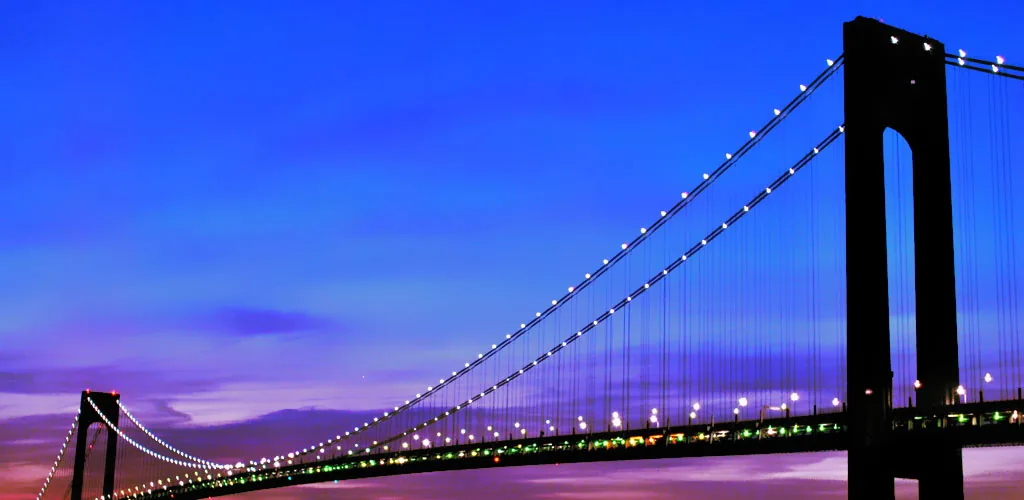
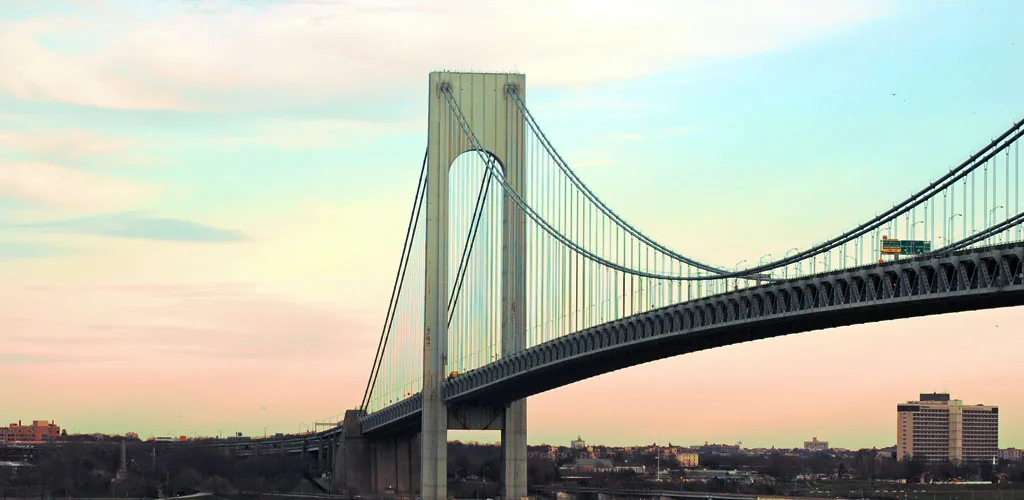
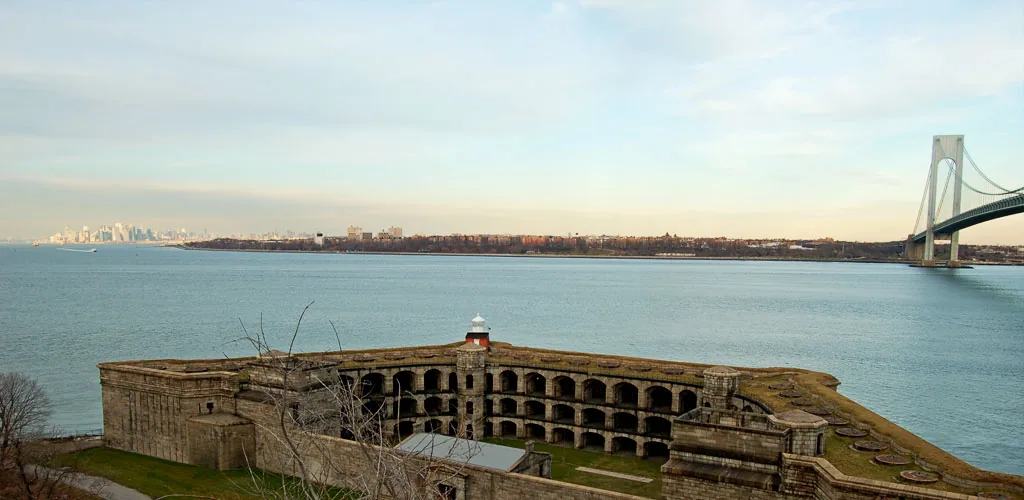
Verrazzano-Narrows Bridge dimensions
The bridge is 4,260 ft between its towers, 9,865 ft between its abutments and 13,700 ft end to end. Its towers stand 693 ft above the water, and the deck leaves 215 ft of clearance over the ship channel at mean high water. Two decks carry 13 lanes.
Below is each measurement with what it does to the crossing itself: the time it takes, the deck it puts you on, the part of the skyline it explains.
The measurements
| Measurement | Figure | What it means when you cross |
|---|---|---|
| Main span, tower to tower | 4,260 ft (1,298 m) | About 65 seconds at 45 mph. This is the section with nothing under it but water. |
| Length between abutments | 9,865 ft (3,007 m) | The operator's length for the structure: about 2 minutes 30 seconds at 45 mph. |
| Total length, end to end | 13,700 ft (4,176 m) | The figure usually quoted for the whole crossing, counted across the approach spans at both ends. |
| Tower height | 693 ft (211 m) above the water | Roughly the height of a 70-story building, and the reason you can pick the bridge out from the Brooklyn Promenade or Coney Island. |
| Clearance under the deck | 215 ft (65.5 m) above mean high water, across a 2,000 ft wide midchannel | Headroom for ships entering New York Harbor. A traveling maintenance platform takes 15 ft off it while the platform is in use. |
| Decks | 2, one above the other | Your approach road decides which one you get. |
| Lanes | 13: six on the upper level, six on the lower, plus a reversible bus/HOV lane on the upper | The thirteenth lane switches direction with the peak. |
| Weight of each tower | 27,000 tons | Held together with three million rivets and one million bolts. |
| Roadway height, summer against winter | 12 ft lower in summer | The steel cables expand in the heat and the deck drops with them. |
The span, tower height, lane count, tower weight, rivet count and seasonal movement are MTA Bridges and Tunnels' own figures. The 9,865 ft is the MTA's measurement between the abutments; the 13,700 ft end-to-end figure is the one New York City Parks publishes for the crossing. The clearance under the deck is the one NOAA charts for the harbor: U.S. Coast Pilot 2, Chapter 11, edition of 8 November 2026, which gives 215 ft of vertical clearance over a 2,000-ft-wide midchannel at mean high water. U.S. Coast Pilot 2, Chapter 11 is published by NOAA's Office of Coast Survey; the Coast Guard's navigation regulations are reproduced in the same pilot.
Which deck you get
Both decks carry traffic in both directions, so "upper" and "lower" is not a choice between going east and going west. On the Staten Island side, Lily Pond Avenue and Narrows Road South let you pick a level; on the Brooklyn side the Belt Parkway and Gowanus Expressway approaches connect to both decks. Hazardous materials must use the upper level, and if the upper level is closed, over-dimensional and hazardous-materials vehicles cannot cross at all.
The ramp-to-deck mapping for all seven approaches, the posted clearance for each deck in each direction, the 9 ft 6 in width limit and the night permit rule are on the how to get to the Verrazzano-Narrows Bridge page.
Why the towers are 693 feet tall, and 1⅝ inches out of line
The towers carry the cables that hold the deck 215 ft above the harbor, so their height is set by the ships below and the geometry above. They are also 1⅝ inches farther apart at their tops than at their bases: over 4,260 ft, the curvature of the earth had to be compensated for, and the towers are set 1,298 m apart.
Each tower weighs 27,000 tons. Nothing about those numbers is decorative — they are the reason the bridge looks the way it does from the shore, with the two towers leaning very slightly outward, their tops 1⅝ inches farther apart than their bases.
What the span means on the drive
4,260 ft is the deck between the towers; at 45 mph you cover it in about 65 seconds. The full 9,865 ft between the abutments takes about two and a half minutes at the same speed. Neither figure is what a peak-hour crossing feels like, because the time is set by how many vehicles are on the road, not by the length of the deck.
For that, use the measured pattern: the busiest hour in each direction, average weekday and weekend rates, and the quiet windows are on the Verrazzano Bridge traffic by hour page. The current speed is on the live traffic page.
Framing it in a photograph
Two numbers set a photograph of this bridge: the 4,260 ft span and the 693 ft towers. You need enough distance for the first and enough sky for the second, which is why the shore-side parks work better than the deck itself. The city's parks department points to the Brooklyn Promenade and Coney Island Beach as places the towers are visible from, and both are a long way from the bridge.
The specific viewpoints, the angles they give and the best light are in our guide to photographing the Verrazzano-Narrows Bridge.
When it was built
| Date | What happened |
|---|---|
| 13 August 1959 | Construction began. New York City's records put the groundbreaking on this date. |
| 21 November 1964 | The upper level opened to traffic — at about 3 p.m., with the first car through paying 50 cents. |
| 28 June 1969 | The lower level opened, turning a single deck into two. |
The bridge was built for USD 320 million and was the longest suspension span in the world when it opened. The story behind those dates — the 1955 plan, the cable spinning, the homes cleared for the Brooklyn approach and the 2018 correction of the spelling to Verrazzano — is on the bridge history page.
What the bridge carries now
Thirteen lanes across two decks took an average of 224,630 vehicles on each weekday in the 12 months to 27 October 2026 — 58,628,516 crossings over 261 weekdays. The toll applies in both directions, with a lower rate for enrolled Staten Island residents; the rates, the payment tiers and the resident program are on the Verrazzano-Narrows Bridge toll page.
Closures take a deck, a ramp or the whole bridge out of service: the marathon in November, the bike tour in May, and overnight maintenance the rest of the year. What is closed now, and what is scheduled, is on the bridge closures page.
Questions about the bridge's size
How long is the Verrazzano-Narrows Bridge?
13,700 ft (4,176 m) end to end, which is about 2.6 miles, and 9,865 ft (3,007 m) between the abutments — about 1.9 miles. The main span between the towers is 4,260 ft (1,298 m).
How tall is the Verrazzano-Narrows Bridge?
The towers stand 693 ft (211 m) above the water, more than three times the 215 ft clearance under the deck. The deck itself is 215 ft above mean high water at the ship channel.
When was the Verrazzano-Narrows Bridge built?
Construction ran from August 1959 to November 1964, when the upper level opened on 21 November. The lower level opened on 28 June 1969.
How old is the bridge?
It has carried traffic since 21 November 1964, so it is more than 60 years old. The lower deck has been in use since 1969.
How many lanes does it have?
13: six on the upper level, six on the lower level, and a reversible bus/HOV lane on the upper level that switches direction with the peak.
Is it the longest suspension bridge in the United States?
It is the longest suspension bridge in North America, and has been since it opened in 1964, when its 4,260 ft span was also the longest in the world.